Tuesday evening I entered a Latter-day Saint temple for the first time in over a decade.
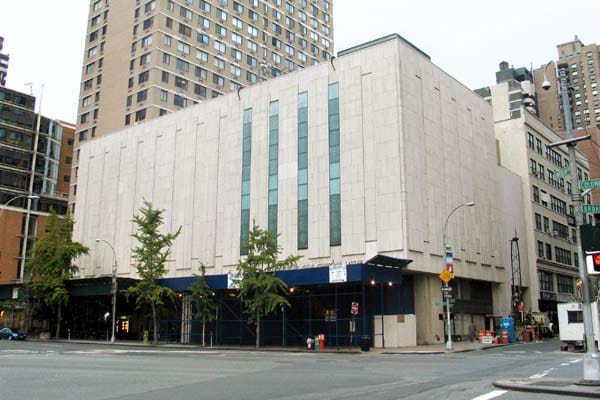
Don't have a stroke—it wasn't a religious relapse. The LDS Church has taken its blocky, six-story meetinghouse near Lincoln Center in Manhattan and hewn from its rocky heart a new temple. (I've touched on the subject of this construction project in earlier writings.) This edifice is open to the public, more or less, through June 5, after which it will be closed to heathen, given a final hard spit and polish, and dedicated to Elohim, as God is known to His friends. My wife █████ and I, along with three intrepid friends, were fortunate enough to attach ourselves to a tour this week.
Having returned, I shall soon report. (If you happen ever to have experienced a Mormon temple endowment ceremony and possess an evolved sense of irreverence, you are busting a gut at that line. Otherwise you're either scratching your head or reaching for a firearm.) But first, a brief word about temples.
A temple-building people
To members of the Church of Jesus Christ of Latter-day Saints (LDS or, less correctly, Mormons), a temple is a building much more holy than a standard Sunday meetinghouse. It is a place where sacred ordinances, or ceremonies, such as baptism for the dead, endowment, and celestial marriage are performed. After its dedication, a temple can only be entered by a worthy member of the LDS Church who carries the proper authorization, in the form of a wallet-sized card signed by his ecclesiastical leaders. It it quite literally, to the faithful, the House of the Lord.
The Church has more than 10,000 meetinghouses scattered around the globe and is building more a rate greater than one every day. Of temples, however, they have only 117 in operation, with a dozen or so others announced or under construction. It should be noted, though, that the number of temples worldwide has far outpaced the growth of Church membership in the past 25 years. Only 17 of those 117 were operational before 1979.
Temple ordinances are so critical to eternal salvation that, in earlier decades, Mormons in remote locales might save for years so they could travel ten thousand miles to spend a day or two in the House of the Lord, and count it money well spent. Nowadays temple attendance is becoming far more convenient for the average Saint. The blessed members of Manhattan, for instance, must no longer make the arduous trek to Boston or D.C. to save their souls and the souls of their ancestors.
But I'm getting ahead of the story.
What really goes on in there?
My little gang of five—❦bobhowe, Jim, Liz, █████ and I—met up on the sidewalk in front of the Manhattan temple at about 7:45 pm on Tuesday, May 18. Of the group, I was the only one who had ever been LDS, let alone seen the inside of a Mormon temple. The other four were raised Catholic, though the indoctrination didn't stick with any of them.
Bob and I had ridden the subway uptown together from work. On the way, he said, "I understand why I'm interested in taking this tour—I'm curious, and everything I see is going to be new to me. But it's less clear why you want to subject yourself to it again."
It was a fair statement. "I haven't been inside a temple since 1992 or 1993," I said, "and then it was mostly the older, established temples. I'm curious to see what the newer ones, where they've streamlined the processes more, look like inside. I'm also curious to see what they will and won't show us, and how they've crammed all the functions into a couple of floors of that building."
Construction equipment still littered the sidewalk, and from all the plywood on the exterior of the building it seemed that restorations to the marble-looking façade were still in progress. A contingent of a dozen young, fresh-scrubbed missionaries waiting outside the entrance to greet arrivals and lure in unsuspecting passersby. At curbside, beyond the LDS property line, stood two or three anti-Mormon pamphleteers, each with his or her own street display. The one nearest us wore a T-shirt reading TRUST JESUS and stood beside a sign detailing what "really" goes on inside a Mormon temple, complete with drawings of little figures in funny robes and hats embracing and making strange gestures. He handed me a booklet published by New Testament Ministries of New Bedford, Texas, in which a couple named Richard and Cindy Benson related their progress from Mormonism to the true worship of Christ. (I skimmed it later and found nothing very interesting about it, with no accusations against the Church I hadn't heard before.)
Lest anyone be confused, an official-looking sign near the missionary cohort said something to the effect that opinions proferred outside temple property were decidedly not the views of the LDS Church.
Our gang of five chatted idly for a few minutes in the cool evening. █████ smoked a cigarette for the benefit of the watching missionaries. At about five minutes to eight we ran their gauntlet—with a brief pause to allow the elders to check our shoulder bags for bombs and video cameras—and entered the temple.
Busy little bees
To be more accurate, we entered the meetinghouse, negotiated a dogleg turn right and left, and congregated with twenty or so other tourgoers in a small foyer. As we would learn in a few minutes more, the temple occupies the fifth and sixth floors of the building, and a portion of the first. We were waiting in the non-temple portion.
The lighting was bright and the walls very white. The room was finished in a trim that looked like a prefabricated wood veneer—neat and clean, semi-ornate, but a little cheap-looking. I realized as we waited for an elevator to arrive that I was nervous. What feelings or flashbacks might arise as I ventured again into the sacred-not-secret guts of a Mormon temple? Would my observations remain clinical, or would the experience scare me? Would the feelings themselves end up scaring me? It wouldn't be the first time my indoctrination overrode my reason.
Our group piled into a wide elevator that would ferry us to the third floor. The interior was all done in the same wood veneer, with a large beehive in bas-relief on each panel. The elevator operator was a portly, balding missionary whose nametag read ELDER BUSH. (He didn't look much older than 22 or 23. Male Mormon missionaries are infamous for premature baldness.) Someone asked if the beehive symbol was religiously significant. Elder Bush said no, it was just a symbol of industry and diligence.
His point was debatable, but I didn't feel I should take up the challenge. The beehive appears in many Church contexts, and also on the flag and seal of the state of Utah. Its provenance is a passage in the Book of Mormon describing the arrival in the Western Hemisphere of an ancient people fleeing the confounding of languages at the Tower of Babel:
And they did also carry with them deseret, which, by interpretation, is a honey bee; and thus they did carry with them swarms of bees, and all manner of that which was upon the face of the land, seeds of every kind.—Ether 2:3
On the basis of this verse, early Mormons seized on "Deseret" as the name for their new territory, and the industriousness of bees as their watchword. ("Industry" is still Utah's state motto.) Of course, you only see the beehive as a religious symbol if you regard the Book of Mormon as a purely religious work. A person can only see it otherwise if he believes the Book of Mormon to be literal history. An esoteric argument for a different day.
Souls in limbo
On the third floor, we were deposited in a large chapel to wait for the start of our tour. The five of us slid into a long pew in the center section. There were maybe forty other people in the chapel, many of them missionaries. The chapel itself was stark. The ceiling was high, with two row of unadorned white globes hanging from the ceiling, giving off light. The walls were white and devoid of ornamentation except for the front wall behind the dais, where a large square patch of primer indicated where painting had yet to be completed. The wooden pews, at least, were solid and stained dark, and had upholstered cushioning.
I tried not to think about the three or four sacrament meetings I had attended in that very chapel, during my brief backslide in 1998.
"I can't get over how bright it is," said Bob when we were seated.
"More used to churches being gloomy and dim?" I asked.
"Sepulchral."
"Mormons aren't big on gloomy churches. Every one I've ever seen has been pretty bright and airy. Of course, most of those were lined with big windows on both sides. This one doesn't even have any windows, which makes the brightness more remarkable."
"This isn't exactly a typical Mormon building," said Jim, who has an uncle who converted to Mormonism years back. "But is this chapel pretty much the same as what you'd see in most churches?"
"Very much so," I said. "The size and layout of the room are very standard."
"That's what I seemed to remember from some of the times we went with my uncle to something at his church," said Jim. "I also notice that you don't see a lot of decoration inside here. Will there be any when the renovation is finished?"
"Mormons don't go in much for iconography in their churches," I said, "though it's a little different in a temple. You wouldn't even see the beehives in most churches, and you won't ever see any crosses."
"Yeah, yeah," said Liz. "I was noticing there weren't any of those around."
"Mormons don't use the cross at all as an icon. You might see some paintings here and there in a Mormon church, but nothing in the chapel itself. Maybe a portrait of Jesus at the front, but that would be about it."
We spoke in hushed voices, like everyone else in the chapel was doing, a group of souls in bright limbo. After another minute or two of chat, a medium-sized fellow in a suit and tie entered the chapel and stepped up to the first pew. He had sandy-grey hair, a youthful face, and a neatly trimmed, almost military-style mustache. A white name badge pinned to his lapel identified him as a volunteer temple worker.
"Is this our tour group?" the man asked in a voice so soft we could barely hear it in the fifth row. He was speaking to us all, but he bent his head in such a way that he seemed only to be looking at the people in the first pew. "Welcome to the House of the Lord. I'm Brother Creigh—you'll find that we all call each other 'Brother' and 'Sister' in the Church—and I'll be your guide here on this tour of the Manhattan New York Temple. We're excited that you're here to learn more about what we do here. We just ask that you help us preserve the atmosphere of reverence in the temple during your visit, and remind you that no picture-taking is permitted."
Brother Creigh turned out to be that soft-spoken for the rest of the tour, although most of the time we were in rooms quiet and close enough that there was no trouble hearing him. After a bit more introductory patter, he led our group of twenty or so out of the chapel down a hall.
Better than most corporate productions
We filed obediently into a small classroom filled with four or five rows of stackable upholstered chairs. At the front of the room, a television sat atop a tall rolling A/V cart which was shrouded in white cloth, like an altar. The television screen showed the DVD VIDEO logo. A volunteer handed us each a pair of elastic-topped white plastic slippers to wear over our shoes. These would protect the light-colored temple carpets from our shoes during our tour. It made me feel as if we were visiting a semiconductor factory.
When we were seated and settled and sanitized for the building's protection, the lights went down and a 13-minute video presentation on temples began. As a narrator delivered calm, reassuring words over a bed of reverent strings, views of different LDS temples around the world panned across the screen. I felt chills crawl up my body, the same chills I had once interpreted as the presence of the Holy Ghost testifying to me of truth. Stop it, I told myself. This is a Pavlovian reaction to long conditioning, I told myself. You feel the same thing during the opening frames of Star Wars. Control it.
I touched my chest briefly. Under my blue dress shirt I was wearing the "X-Mormon" T-shirt (based on a design sent in by a loyal reader) for which I had done the graphic design. Between the realization of why I was feeling what I was feeling, the reminder of my true convictions, and the presence of my gentile family and friends, I got the "rightness chills" under control. I didn't feel them again for the remainder of the tour.
The video offered us a sketchy history of temple-building in the ancient and modern worlds, touching on Moses's portable desert tabernacle and Joseph Smith's constructions in 1830s Ohio and Illinois. The narrative followed the persecuted early Saints west to the shores of the Great Salt Lake where they began the forty years of construction that would culminate in 1893 with the dedication of the iconic Salt Lake Temple. Interspersed with this narrative were sound bites from a couple of talking heads, professors from the Department of Ancient Scripture at Brigham Young University. (I mentally translated the name of their college to "Department of Wishful Archaeology.")
This put me on alert for references to the Book of Mormon (one of those "ancient scriptures" they study at BYU, together with the Bible and the Pearl of Great Price) during the remainder of video. But despite the prominence of Joseph Smith in its first half, no mention was made of the grand second testament of Christ he produced in the late 1820s, a book that the Church promotes as "the keystone of our religion." In fact, no mention was made of the Book of Mormon for the duration of the tour. The focus was squarely on Jesus Christ, and on the doctrine of eternal familes, which received due attention in the second half of the video, with apostles like Boyd K. Packer and even the Mormon prophet, Gordon B. Hinckley, extolling the importance of temples in helping families be together forever.
After the video, the lights came up. We blinked as Brother Creigh explained to us how the Manhattan temple was unique in the LDS world in that most temples, as we had seen in the video, were expansive structures on wide expanses of manicured grounds in suburban setting. This one was the only temple besides Hong Kong's to be fashioned from an existing building, and the only one at all in which the sacred and restricted temple portions were tetrissed together with a general-access meetinghouse.
(My suspicion is that a Manhattan temple would never have been built had the Church's plans for a temple in Harrison, near White Plains, not bogged down in several years' worth of litigation. But I figured it wouldn't have been politic to raise my hand and ask Brother Creigh to comment.)
"We'll move back down to the first floor now and enter the temple proper," said Brother Creigh. "If you have questions while we're moving, feel free to ask, but there will be an opportunity to ask questions also at the end of the tour."
As we followed Brother Creigh back out of the classroom, Bob said to me, "That video was really well done. Very professional. I've seen corporate PR films that weren't nearly that accomplished."
"They've done their own production in-house for a long time, and they spare no expense," I said.
"You can tell. They do an impressive job."
"The Church is quite the PR machine."
From the time we first heard the announcement of the temple construction, █████ and I had been keeping an ear cocked for word of the open-house tours which would surely follow. When we finally did hear, the word came in a morning news story on WNYC, our local NPR affiliate. The Church PR machine was nothing to underestimate.
We five followed along helplessly as it carried us to the elevators.
Author

Hugo and Nebula Award nominee. Creator of Proper Manuscript Format, Spelling Bee Solver, Tylogram, and more. Banned in Canada.
Sign up for William Shunn newsletters.
Stay up to date with curated collection of our top stories.